The Maximum Height a Typical Human Can Jump From a Crouched Start Is About 60.0 Cm .
Chetah Profile
The Cheetah is a big, slender cat that live in sub-Saharan Africa, and in eastern and southern African parks. Cheetahs tin also exist constitute in small numbers in southern Algeria, northern Niger and Iran.
The Cheetah is the fastest state animal on the planet. They are members of the family Felidae, which includes the tiger, lion, jaguar, leopard, snow leopard, and other big cats.
Cheetah Facts Overview
| Habitat: | Dry Grasslands, Scrub Forests & Savannahs. |
| Location: | sub-Saharan Africa, eastern and southern Africa, southern People's democratic republic of algeria, northern Niger and Iran |
| Lifespan: | 15 – 20 Years |
| Size: | 112 – 150 cm (45 – lx in) |
| Weight: | 46 – 159 pounds (21 – 72 kg) |
| Color: | Tan with blackness spots |
| Nutrition: | Gazelles, Wildebeest, Impalas, Rabbits, Birds, Hares, Antelopes, & Warthogs |
| Predators: | Lions, Leopards, Hyenas, Eagles (Immature cubs) |
| Superlative Speed: | 100 kph (65 mph) |
| No. of Species: | i |
| Conservation Status: | Vulnerable |
Cheetahs are establish in open and dry grasslands in the Sub-Saharan region of Africa, although they were one time widespread throughout Africa and Asia. The bulk of Cheetahs today inhabit natural reserves or parks.
Cheetahs in the wild typically alive betwixt 10 – 15 years in the wild. Some can accomplish 20 years of age while in captivity.
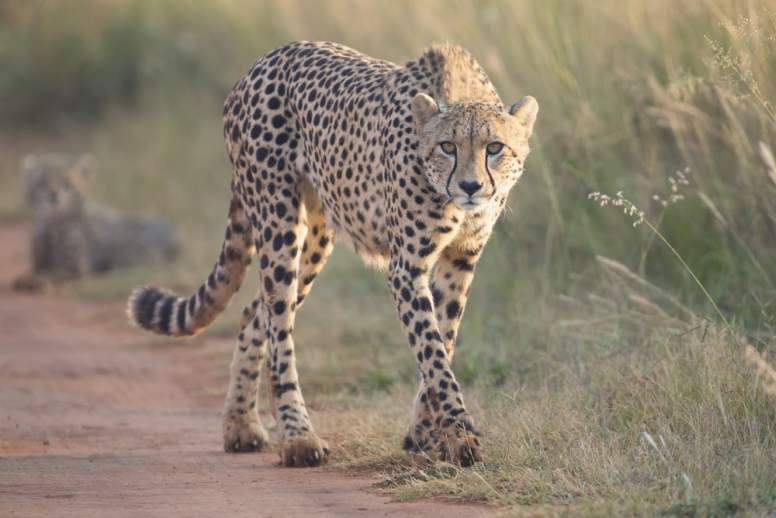
The Cheetah has a slender body with long legs and is clearly designed for speed. They are tan in color with a massive covering of black spots all over the torso. The unique patterns of the spots are as distinctive as fingerprints are on humans.
Cheetahs are easy to distinguish from other large cats as they are smaller in size, have a smaller caput and ears than nearly other cats, take a spotted glaze and conduct what are known as tear stripes that run from the corner of each heart to the side of their olfactory organ.
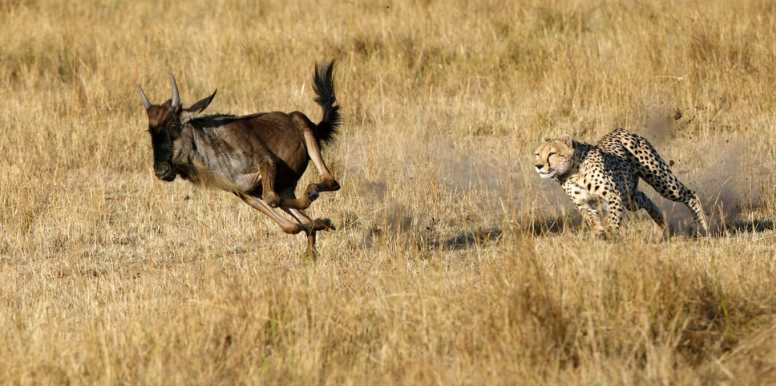
These meat eaters typically hunt and eat impalas, wildebeest calves, gazelles and other smaller hoofed animals. They are diurnal, which means they hunt during the solar day and rely on tall grasses to hide when on the hunt. Cheetahs generally hunt in either the tardily morning or early on evening.
A typical chase can last between twenty and sixty-seconds with only one-half of them being successful. They have big non-retractable claws that are used to prevent skidding when cornering quickly, and to pull downward an animal.
Interesting Cheetah Facts
1. Cheetahs are the fastest land beast in the globe.
These cats are fast. They can typically achieve speeds of up to 98 kilometers per hour (61 miles per hour), and can go from 0 to 60 Mph in just 3-seconds, which is faster than nigh super-cars. Their footstep length becomes as long as 7m (23ft) at total step, which means the cheetah spends more than half the time airborne. one
2. Cheetahs don't simply rely on their speed, they anticipate the escape tactics of different prey when hunting.
A squad or researchers found that Cheetahs hunting tactics were specific to characteristics of their casualty, and are far more sophisticated than thought. two
3. The Chetah tail helps them steer at loftier speed.
Information technology may wait big and cumbersome, but when on the chase, the tail of the Cheetah plays an important role. Information technology actually helps to steer the chetah equally it runs, like a rudder on a boat.
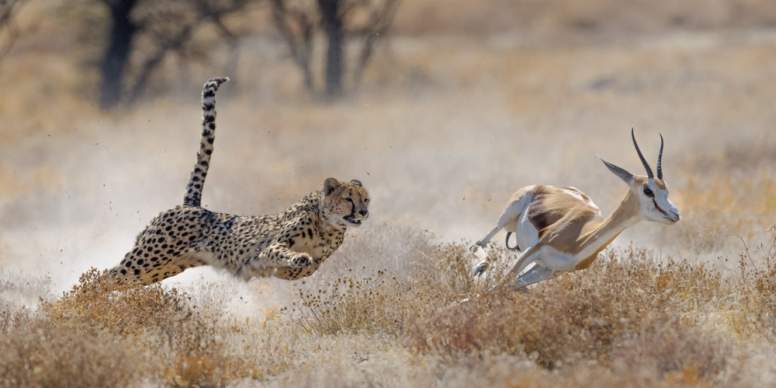
It's not a cheetahs speed that's their greatest attribute when hunting, information technology's this agility — their skill at jumping sideways, changing directions quickly and slowing down well-nigh instantly. 3
4. Cheetahs tire quickly.
Due to the energy required to run at such speed, cheetahs can simply maintain a chase for between 200 – 300m. If a hunt isn't successful afterward 1 min, they usually stop to residue.
v. Fossils take revealed that Cheetahs date mode, manner back.
Carbon dating has estimated the historic period of some cheetah fossils as being between ane and two million years old.
half-dozen. Cheetah can't roar.
Dissimilar big cats similar the panthera leo, cheetahs are unable to roar. They are closer to your domestic house cat in that they can purr, both inhaling and exhaling.
vii. Female person adult cheetahs often alive lonely.
Known to be typically alone animals, females heighten their cubs alone for about a twelvemonth before they leave. Male cheetahs sometimes will alive in a small group of brothers from the same litter.
8. Cheetahs abandon around 10% of kills to larger predators.
In order to prevent losing their kill to some other big and nasty carnivore (Lions, hyenas or even vultures), Cheetahs will move their prey to a secluded spot, and consume quickly. They will as well hunt during the day when predators are generally asleep, and just end up abandoning a relatively small number of kills. 4
ix. The cheetahs spots act as camouflage.
The chetah tin can have between 2,000 and 3,000 spots, to assistance it blend into environment when hunting or hiding from predators.
10. In that location is no end to the cheetah mating season.
Cheetahs can mate any time of the year with gestation lasting simply iii months. A litter can range between 2 and 4 cubs.
11. Chetah cubs have a very different coat to that of adults.
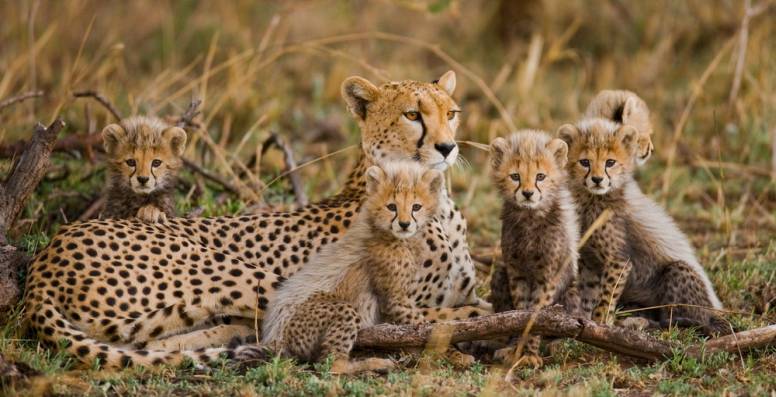
The cubs have a smoky colored, long, wooly coat called a curtain. It runs down their backs and acts equally a course of camouflage. It helps to muffle the cubs and their mothers assist in this by constantly seeking places to 'hide' them to protect the cubs from predators until they are erstwhile enough to take care of themselves.
12. Cubs go moved around a lot.
Female cheetahs volition motility their cubs to dissimilar hiding places every few days. One time the cubs reach 5 or 6 weeks of age, they will follow their mothers and even starting time eating from their kills. By the time the cubs reach i twelvemonth of age, they are hunting on their own. At 15 months, they will move away from their mother and either notice a mate or sometimes live in a small grouping.
13. Cheetahs are non that thirsty…for h2o that is.
Having adapted for life in an surround where at that place is piddling h2o, cheetahs can become three to iv days without a driblet of it. That doesn't mean that they don't actually get any liquids at all. As it turns out, cheetahs are able to draw water from the animals they hunt, kill and consume.
14. Cheetahs start families early.
The male can reproduce at the historic period of one while females tin can begin rearing families at the age of 2. The pairing is more often than not random as cheetahs volition mate with many different cheetahs during their lifetime.
15. Females end upwardly raising their young lonely.
Males practice not participate in the rearing of their young all the same, females have been described equally caring, affectionate and defended mothers.
16. Cheetah cubs take a shockingly loftier mortality charge per unit.
1 study in the 90'due south the Serengeti found that 95% of cubs died earlier reaching adulthood. Many deaths were due to Lions, but also other predators and disease. five
17. Cheetahs can practice something no other true cat can do.
The Cheetah is the only large true cat that is capable of turning in mid-air while sprinting.
18. It's a myth that cheetahs abandon hunts due to overheating when running.
Two Harvard scientists in 1973 set-upwards an artificial experiment in a laboratory, that that concluded a cheetah would exist forced to end running when their body temperature reached forty.5 degrees Celsius.
However, new research in existent globe conditions shows that cheetahs body temperatures never ascension that high in the wild, and they don't abandon hunts due to overheating. half-dozen
xix. Cheetahs have been around for a very, very long time.
Sumerians trained cheetahs for hunting dorsum in 3000 BC. The Indian (and so Hindustan) ruler Emperor Akbar had one,000 trained cheetahs he used for hunting while in power from 1556 to 1605. Even King Tut's tomb (1400 BC) independent diverse cheetah artifacts. It was because of this that historians believed that the cheetah was a sacred creature to ancient Egyptians.
20. Cheetahs are slowly disappearing from the planet.
At the turn of the 20th century there were well over 100,000 cheetahs. Today the numbers are considerably less with roughly 7,000 in Africa and a few hundred in Islamic republic of iran. They have been driven out of their historic range past humans, and are at present merely plant in Algeria, Angola, Northern Niger, Namibia, Zimbabwe, Botswana, Southward Africa, and Mozambique. The species is already almost extinct in Asia, with fewer than 50 individuals remaining in one isolated pocket of Iran. 7
Cheetah Fact-File Summary
Scientific Nomenclature
| Kingdom: | Animalia |
| Phylum: | Chordata |
| Class: | Mammalia |
| Order: | Carnivora |
| Infraorder: | Cetacea |
| Suborder: | Feliformia |
| Family unit: | Felidae |
| Subfamily: | Felinae |
| Genus: | Acinonyx |
| Species Proper noun: | Acinonyx Jubatus |
Fact Sources & References
- "The Truth About Cheetahs" (2014), via BBC Earth.
- "New insight into how Cheetahs catch their prey" (2013), via Science Daily.
- "Cheetahs' Secret Weapon: A Tight Turning Radius" (2013), via NY Times.
- "To flee or not to flee: predator abstention by cheetahs at kills" (2006), via Springer Link
- "Five Things That Might Surprise You Nigh Cheetahs" (2017), via BBC Earth.
- "It'south a Myth That Cheetahs Overheat While Hunting" (2013), via National Geographic.
- "Cheetahs Are Dangerously Close to Extinction" (2016), via the National Academy of Sciences
hendersonherry1988.blogspot.com
Source: https://factanimal.com/cheetahs/
0 Response to "The Maximum Height a Typical Human Can Jump From a Crouched Start Is About 60.0 Cm ."
ارسال یک نظر